


Introduction
LSESU Economics Society
The London School of Economics and Political Science (LSE) is a world-leading institution for economics education and research, with its economics programmes consistently ranked among the top in the world. Specifically, its Economics and Econometrics subject is ranked 1st in the UK by QS. Drawing on LSE’s exceptional academic resources in economics, the LSE Economics Challenge is designed and reviewed by LSE economics professors, with a core mission of "bridging high school education and undergraduate economics studies at LSE".
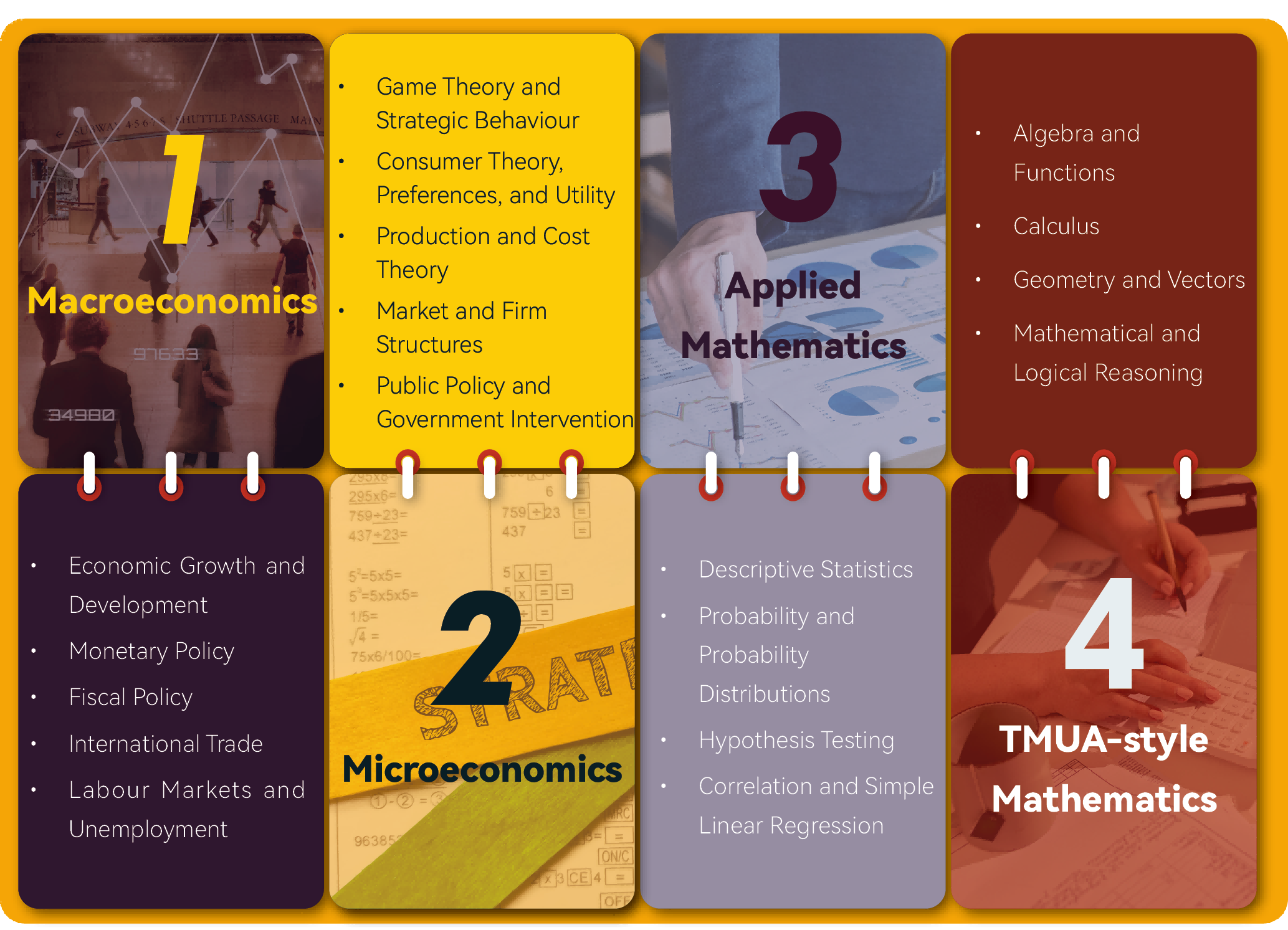
The challenge covers not only foundational theories and qualitative analysis skills in macroeconomics and microeconomics, but also innovatively integrates theoretical and applied mathematics modules, highlighting the central role of mathematics and computational skills in economics. It aims to cultivate interdisciplinary talents who can use mathematical tools to solve economic problems, enabling students to adapt to the global trend of increasing mathematization in economics and advance to the frontier of the discipline. The inaugural 2025–2026 edition has already reached over 20 countries and regions worldwide, establishing an international platform for academic exchange in economics.
Consultant Professor

Dr. Judith Shapiro
Supporting Professor
Dr. Judith Shapiro is a Senior Lecturer in Practice at LSE’s Department of Economics. With experience at the UNECE and New Economic School (Moscow), she is dedicated to nurturing the next generation of economists.
LSESU Economics
LSE Economics and Econometrics
ranked 1 in the QS UK ranking
Integrate the international high school curriculum with the core content of LSE
undergraduate economics
Economics X Mathematics
LSE is a global leader in economics education and research, with its Economics and Econometrics programme ranked 1st in the UK by QS. It will launch a new "Economics and Data Science" major in the 2026 application cycle.
Economics provides the theoretical framework, while mathematics offers the logical tools and empirical methods that make economics a more scientific, precise discipline. In the big data era, sectors like tech, fintech, investment banking and public policy demand talent with both economic literacy and strong quantitative skills.
The LSESU Economics Society's Economics Challenge reflects this forward-looking vision. Developed and reviewed by LSE economics professors, it bridges high school and undergraduate economics education. Covering macro/microeconomic theory and qualitative analysis, the challenge also integrates TMUA-aligned theoretical and applied mathematics modules, emphasizing the role of math and computing in economics. It aims to nurture interdisciplinary talents who can solve economic problems with mathematical tools, preparing students for the increasingly quantitative global economics landscape.
Academic Syllabus
Sample Questions
This challenge is designed with 50% of the high-school curriculum and 50% of the LSE economics year one undergraduate studies. By encouraging students to learn more content outside of high school curriculum, participants wishing to apply to study Economics at university will have a better idea of what it maybe like to study Economics at a higher level.
The questions in the competition was set and academically reviewed by an LSE economics professor.


1.
Explanation:
Inflation rate = percentage change of CPI = ((130/75)-1)x100%2.
Explanation:
multiplier = 1/(1-MPC) = 1/ (1-0.75) =4.
Potential change in national change income = multiplier x tax change x MPC = 4x60x0.75=180

3.
Explanation:
Economic profit = Accounting profit – Implicit cost = $80,000 - $30,000 - $60,000 = -$10,000.4.
| Number of workers | Quantity of Notebook |
|---|---|
| 0 | 0 |
| 1 | 10 |
| 2 | 21 |
| 3 | 28 |
| 4 | 33 |
Explanation:
The firm maximizes profit where the value of the additional worker’s contribution (Marginal revenue) is just equal to or greater than the wage(Marginal cost). Hiring a third worker would add only $21 of revenue while costing $23, leading to a loss. Thus, the profit-maximizing number of workers is 2.
5.
Explanation:
The expected value of a discrete random variable is calculated as the sum of each possible value multiplied by its probability.For random variable X,which takes the value 2 with probability 0.4 and 10 with probability 0.6,E [X]=(20.4)+(100 .6)=0.8 +6=6.80.The variance of a discrete random variable is calculated as E[X²]-(E[X])². First, calculate E[X²]:E[X²]=(2²0.4)+(10²0.6)=(40 .4)+(1000 .6)=1.6 +60 =61.6.Then, Var[X]=61.6 -(6 .80)²=61.6 -46.24 =15.36.6.
Explanation:
The t-statistic measures the ratio of the magnitude of an estimate to its standard error.It is calculated as the estimate divided by the standard error.Substituting these values into the t-statistic formula gives 2.5 /0.5 =5.00.
7.
A.3
B.4
C.5
D.6
Explanation:
We have (1 + 3cos3θ)2 = 4 if and only if 1 + 3cos3θ = ±2. We consider each possibility separately.
We have1 +3cos3θ = 2
if and only if 3cos3θ = 1
if and only if cos3θ = 1/3.
Since 0° ≤ θ ≤ 180° , we have 0° ≤ 3θ ≤ 540° , and there are 3 values of 3θ which have cos3θ = 1/3 in this interval. (One is
between 0° and 90° , one is between 270° and 360° , and one is between 360° and 450° , by considering the graph of y =
cosx.)
Now considering the other possibility, we have1 +3cos3θ = − 2
if and only if 3cos3θ = − 3
if and only if cos3θ = − 1.
Again, 0° ≤ 3θ ≤ 540° , but this time there are only 2 values of 3θ which satisfy the equation: 3θ = 180 and 3θ = 540° .
Neither of these values of 3θ overlap with the values of 3θ found earlier, so in total there are 3 +2 = 5 values of 3θ in the
interval 0° ≤ 3θ ≤ 540° , and hence 5 solutions to the original
equation in the given interval. The correct answer is option C.
8.
Which one of the following statements is a sufficient condition for exactly three of the other four statements?
A. x ≥ 0
B. x = 1
C. x = 0 or x = 1
D. x ≥ 0 or x ≤ 1
E. x ≥ 0 and x ≤ 1
Explanation:
We work through them sequentially:
A If x ≥ 0, then B may be false, C may be false, D may be false and E may be false
B If x=1, then A is true, C is true, D is true and E is true
C If x=0 or x=1, then A is true, B may be false, D is true and E is true
D If x ≥ 0 or x ≤ 1, then A may be false (for example if x = − 1), B may be false, C may be false and E may be
false
E If x ≥ 0 and x ≤ 1, then A is true, B may be false, C may be false and D is true
The correct option is therefore C, which is sufficient for exactly three of the other four statements.
Rule
- Eligibility: Grades 9-12 High School Students
- Format: Individual, 50 MCQ
- Duration: 90 minutes
- Language: English
- Date: January 9, 2027
- Location: online / on campus