


简介
LSE 经济学挑战LSESU Economics Society Essay Competition
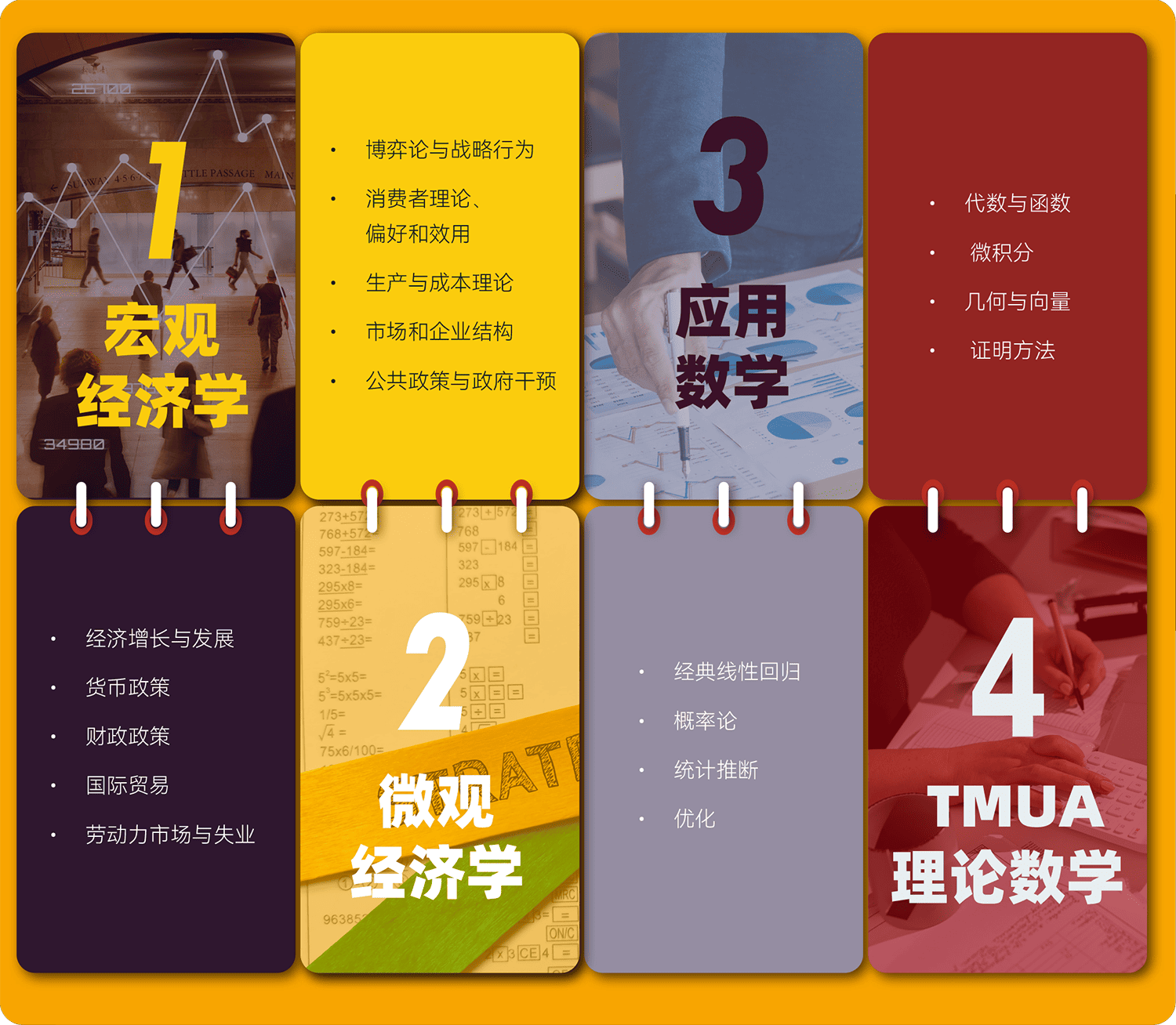
伦敦政治经济学院 (LSE) 作为全球经济学教育与研究的顶尖殿堂,其经济学专业常年稳居世界前列,其中经济学与计量经济学专业位列 QS 英国排名第一。依托 LSE 优质经济学学术资源,LSE 经济学挑战由 LSE 经济学教授亲自命题审核,以 “衔接高中与 LSE 本科经济学教育”为核心定位。挑战内容不仅涵盖宏观经济学、微观经济学的基础理论与定性分析能力,更创新性地融合了理论与应用数学模块,突出数学与计算能力在经济学中的核心地位,旨在培养能够利用数学工具来解决经济问题的复合型人才,推动学生顺应经济学日益数理化的全球趋势,走向经济学前沿。
2025-2026年首届举办就已覆盖全球20+国家及地区,构建起国际化的经济学学术交流平台。
顾问教授

Dr. Judith Shapiro
Supporting Professor
现任教于伦敦政治经济学院(LSE)经济学系。她曾担任日内瓦联合国欧洲经济委员会转型经济科科长,和莫斯科研 究生新经济学院教授、学术协调员和研究中心联合主席,专注于培养下一代经济学家。
LSESU 经济学挑战
LSE 经济学与计量经济学
排名英国第1
LSE 经济学挑战融合国际高中课程与 LSE 本科经济学核心内容
经济 × 数学
伦敦政治经济学院 (LSE) 作为全球经济学教育与研究的顶尖殿堂,其经济学专业常年稳居世界前列。其中经济学与计量经济学专业位列 QS 英国排名第一。并在 2026 年申请季推出全新专业——经济与数据科学专业。为何 LSE 如此重视经济和数学的结合?因为前者奠定了理论基石,后者提供了逻辑工具和实证方法,使经济学从一门思辨性的社会科学转变为一门更具科学性、精确性和预测性的学科。在大数据时代,不论是互联网、金融科技、投资银行、公共政策等领域,都高度依赖既懂经济学又具备强大数学分析能力的人才。
本次 LSE 经济学会发起的经济学挑战项目,充分体现了其在经济学人才培养方面的前瞻性洞察。依托 LSE 优质经济学学术资源,LSE 经济学挑战由 LSE 经济学教授亲自命题审核,以 “衔接高中与 LSE 本科经济学教育”为核心定位。挑战内容不仅涵盖宏观经济学、微观经济学的基础理论与定性分析能力,更创新性地融合了TMUA考核体系的理论数学模块与应用数学模块,突出数学与计算能力在经济学中的核心地位,旨在培养能够利用多元数学工具来解决经济问题的复合型人才,推动学生顺应经济学日益数理化的全球趋势,走向经济学前沿。
学术模块
样题
本挑战设计为50%高中标化课程标准,50% LSE经济本科大一标准的题目。咬合衔接升学知识点,帮助申请英国名校方向的经济菁英锚定正确方向,定向拉伸知识技能。
本挑战题目由LSE经济学教授亲自命题与学术审核


1.
Explanation:
Inflation rate = percentage change of CPI = ((130/75)-1)x100%2.
Explanation:
multiplier = 1/(1-MPC) = 1/ (1-0.75) =4.
Potential change in national change income = multiplier x tax change x MPC = 4x60x0.75=180

3.
Explanation:
Economic profit = Accounting profit – Implicit cost = $80,000 - $30,000 - $60,000 = -$10,000.4.
| Number of workers | Quantity of Notebook |
|---|---|
| 0 | 0 |
| 1 | 10 |
| 2 | 21 |
| 3 | 28 |
| 4 | 33 |
Explanation:
The firm maximizes profit where the value of the additional worker’s contribution (Marginal revenue) is just equal to or greater than the wage(Marginal cost). Hiring a third worker would add only $21 of revenue while costing $23, leading to a loss. Thus, the profit-maximizing number of workers is 2.
5.
Explanation:
The expected value of a discrete random variable is calculated as the sum of each possible value multiplied by its probability.For random variable X,which takes the value 2 with probability 0.4 and 10 with probability 0.6,E [X]=(20.4)+(100 .6)=0.8 +6=6.80.The variance of a discrete random variable is calculated as E[X²]-(E[X])². First, calculate E[X²]:E[X²]=(2²0.4)+(10²0.6)=(40 .4)+(1000 .6)=1.6 +60 =61.6.Then, Var[X]=61.6 -(6 .80)²=61.6 -46.24 =15.36.6.
Explanation:
The t-statistic measures the ratio of the magnitude of an estimate to its standard error.It is calculated as the estimate divided by the standard error.Substituting these values into the t-statistic formula gives 2.5 /0.5 =5.00.
7.
A.3
B.4
C.5 √
D.6
Explanation:
We have (1 + 3cos3θ)2 = 4 if and only if 1 + 3cos3θ = ±2. We consider each possibility separately.
We have1 +3cos3θ = 2
if and only if 3cos3θ = 1
if and only if cos3θ = 1/3.
Since 0° ≤ θ ≤ 180° , we have 0° ≤ 3θ ≤ 540° , and there are 3 values of 3θ which have cos3θ = 1/3 in this interval. (One is
between 0° and 90° , one is between 270° and 360° , and one is between 360° and 450° , by considering the graph of y =
cosx.)
Now considering the other possibility, we have1 +3cos3θ = − 2
if and only if 3cos3θ = − 3
if and only if cos3θ = − 1.
Again, 0° ≤ 3θ ≤ 540° , but this time there are only 2 values of 3θ which satisfy the equation: 3θ = 180 and 3θ = 540° .
Neither of these values of 3θ overlap with the values of 3θ found earlier, so in total there are 3 +2 = 5 values of 3θ in the
interval 0° ≤ 3θ ≤ 540° , and hence 5 solutions to the original
equation in the given interval. The correct answer is option C.
8.
Which one of the following statements is a sufficient condition for exactly three of the other four statements?
A. x ≥ 0
B. x = 1
C. x = 0 or x = 1 √
D. x ≥ 0 or x ≤ 1
E. x ≥ 0 and x ≤ 1
Explanation:
We work through them sequentially:
A If x ≥ 0, then B may be false, C may be false, D may be false and E may be false
B If x=1, then A is true, C is true, D is true and E is true
C If x=0 or x=1, then A is true, B may be false, D is true and E is true
D If x ≥ 0 or x ≤ 1, then A may be false (for example if x = − 1), B may be false, C may be false and E may be
false
E If x ≥ 0 and x ≤ 1, then A is true, B may be false, C may be false and D is true
The correct option is therefore C, which is sufficient for exactly three of the other four statements.
挑战规则
- 适合年级:适合年级:9-12年级
- 形式:50道选择题(线上/线下纸质)
- 时长:90分钟
- 语言:英文
- 参与形式:个人挑战
- 挑战日期:2027年1月